
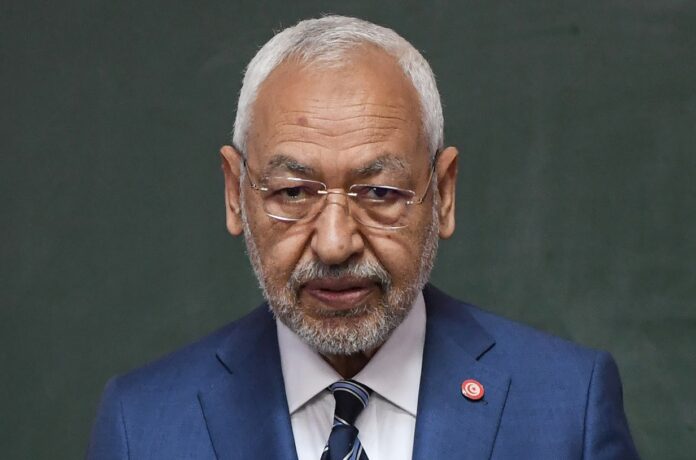
It was late on Tuesday evening when the verdict finally fell. Inside the courtroom of the specialized criminal chamber for terrorism cases at the Tunis Court of First Instance, the judge’s words landed like thunder in an already storm-laden sky. Life imprisonment. Thirty additional years. For Rached Ghannouchi, 84, founder and president of the Islamist movement Ennahda, the sentence seals a political and judicial journey spanning more than half a century. Around him, on that same defendants’ bench, stood dozens of names Tunisia knows all too well — men who once held the reins of power in the years following the 2011 revolution. Men who, on this evening of June 2, 2026, heard their fate close in around them.
A Night of Verdicts, Decades of Prison
Thirty-five defendants. Sentences ranging from ten years to life imprisonment. The court showed no leniency toward the central figures of this case. Mustapha Khedher, whose name had circulated in judicial circles for years, received the most crushing punishment of all: life imprisonment, to which ninety-six additional years were attached. A figure that defies comprehension, a symbol of the extreme gravity of the criminal charges brought against him.
Next came Ridha Barouni, Taher Boubahri, Kamel Aïfi and seven other defendants, also sentenced to life imprisonment combined with seventy-six additional years. Fathi Beldi received life plus fifty years. Abdelaziz Daghsni, life plus thirty-seven years. Kamel Bedoui, life plus thirty-two years. Samir Hannachi, life plus thirty years. Rached Ghannouchi himself sits within this same category — a life sentence compounded by thirty years of additional imprisonment.
The fixed-term sentences were scarcely more lenient. Kaïs Bacar was condemned to forty-eight years in prison. Belhassen Naccache to forty-six. Ali Larayedh, former prime minister and Ennahda’s historic second-in-command, to forty-two years. Ali Ferchichi to thirty-four. Other defendants received sentences of ten, twelve or eighteen years — punishments that, in any other context, would be considered severe, yet here appear almost modest against the backdrop of the full picture. Without exception, every convicted person was also placed under administrative surveillance for five additional years following the completion of their sentence.
The court found the defendants guilty of several terrorism-related offenses: forming and joining a terrorist organization, and placing skills and expertise at the disposal of such an organization — charges that Tunisia’s counter-terrorism legislation punishes without ambiguity.
2013: Where Everything Begins
To understand this verdict, one must travel back thirteen years. In 2013, Tunisia was living through a period of intense political turbulence. On February 6, Chokri Belaïd, a charismatic figure of the Tunisian left, was shot dead outside his home at dawn. Six months later, on July 25, Mohamed Brahmi, a parliamentarian and nationalist activist, fell in turn to an assassin’s bullets. Two murders, two traumas, and a single question that remained without a definitive answer for years: who ordered these killings?
It was this question that the legal defense committee for the families of Belaïd and Brahmi brought before the courts in 2022, pointing the finger at what they call Ennahda’s “secret apparatus” — a clandestine structure that allegedly operated outside all legality, infiltrating state services, gathering intelligence, and, according to the prosecution, planning violent actions. Rached Ghannouchi is presented not as a bystander, but as the direct supervisor of this apparatus.
Ennahda, for its part, has always issued a categorical denial. The party rejects the very existence of such an apparatus and has condemned the proceedings from the outset as a political instrumentalization of justice, designed to eliminate the opposition.
A Party, a Revolution, a Fall
The history of Ennahda is inseparable from that of contemporary Tunisia. Born in clandestinity under the repression of Bourguiba, then Ben Ali, the movement survived decades of persecution before triumphing at the ballot box in October 2011, just months after the regime’s collapse. It was a historic moment — the first Islamist party to win free elections in the Arab world. Ghannouchi returned from a long London exile carrying the reputation of a liberal theologian, an advocate for an Islam compatible with democracy.
But the exercise of power quickly exposed the tensions running beneath the country’s surface. The 2013 assassinations, the economic crises, and the accusations of institutional infiltration gradually eroded the confidence of large sections of Tunisian society in the movement. When Kaïs Saïed suspended parliament in July 2021 and consolidated his grip over every lever of the state, Ennahda found itself squarely in the crosshairs of systematic judicial repression.
Since his arrest in April 2023, Ghannouchi has faced trial after trial, conviction after conviction. His party’s offices were shut down. His successors imprisoned. The movement that was once the country’s dominant political force is today a decapitated structure, its senior leadership either behind bars or in exile.
The Question That Remains
On this evening of June 2, 2026, Tunisia has rendered its legal judgment. But the questions this verdict raises cannot be locked inside a courtroom. Between those who see in these convictions the legitimate culmination of a long search for truth on behalf of the families of Belaïd and Brahmi, and those who read in them the judicial execution of a political movement by a power without counterweight, the divide is deep — and it will remain so long after the courthouse doors have been shut.