
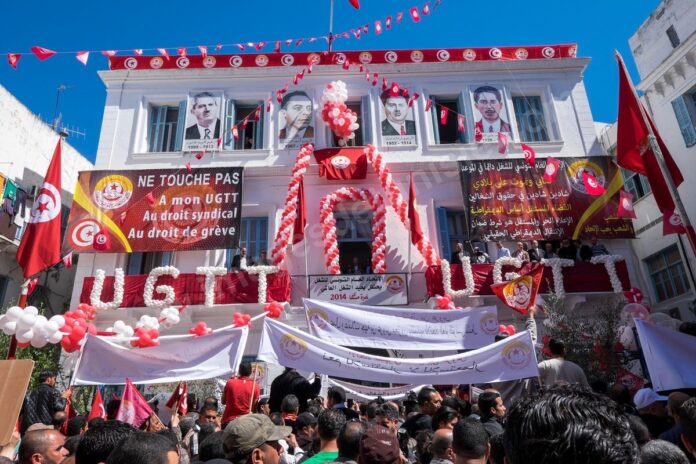
Meeting on September 9, 2026, at the historic headquarters of the Tunisian General Labour Union (UGTT) on Place Mohamed-Ali in Tunis, the union’s National Administrative Committee, chaired by Secretary-General Sofiane Salmi, reviewed a wide range of issues shaping Tunisia’s social landscape: eroding purchasing power, strained public services, the situation of trade unionists and journalists, and the migrant tragedy off Ben Guerdane. At the end of the meeting, the union released a statement reaffirming a decision already adopted at its 26th congress: to move ahead with a general strike, now entrusted to its national executive bureau for implementation.
Purchasing power at the heart of the statement
The National Administrative Committee’s statement opens with a stark social assessment: a continuing decline in purchasing power, rising prices, and deteriorating public services in health, education and transport. The UGTT also denounces recurring disruptions in access to water, electricity, medicine and basic goods, pointing to persistent employment and regional development crises that it says affect broad segments of the population.
In response, the union calls for an emergency national plan for economic and social recovery, built around protecting purchasing power, fighting speculation and corruption, supporting public enterprises, and prioritizing employment and regional development.
Support for labor movements and solidarity with Ben Guerdane
The union praises the social movements seen in recent months across several sectors, including mining, banking, transport, education, and the private sector in Sfax and Ben Arous, and expresses its principled support for protests by unemployed graduates. It rejects any attempt to criminalize social protest or treat what it calls legitimate demands as a security matter.
The statement also expresses solidarity with the residents of Ben Guerdane and the families of victims of a migrant boat that sank off the Tunisian coast, praising local residents’ efforts in the search operations. The union draws a broader conclusion from this tragedy, calling for a national policy on development, employment and youth protection, which it says is the only way to end a situation pushing some young Tunisians to risk their lives attempting irregular migration.
Union rights, judicial independence and press freedom
The National Administrative Committee denounces what it describes as attacks on union work and calls for the release of trade unionists it considers imprisoned, along with an end to legal proceedings against them. It reaffirms the UGTT’s commitment to its independence as a national social force.
The statement also affirms the union’s attachment to judicial independence and fair-trial guarantees, as well as the right of associations, parties and organizations to operate within the law. It expresses UGTT’s support for journalists and press freedom, calls for the release of anyone it says is imprisoned over their opinions or peaceful activities, and denounces what it calls harsh detention conditions in Tunisian prisons.
From strike principle to implementation
At the core of the statement is the National Administrative Committee’s confirmation of its commitment to the general strike decision adopted at the UGTT’s 26th congress, which it presents as a binding commitment of the organization and its membership. It has tasked the national executive bureau with drawing up, in coordination with a civil-society coordination framework, a step-by-step action plan leading up to the strike, and has called on regional unions, federations and local branches to prepare their own action plans in line with the national one.
The statement closes by reaffirming UGTT’s solidarity with the Palestinian people and calling for the release of prisoners from the Sumud flotilla.
A union with historic weight in Tunisian politics
The UGTT holds a distinctive place in Tunisia’s political history, notably for its role in the 2013-2014 National Dialogue, recognized by the 2015 Nobel Peace Prize awarded to a quartet of organizations that included the union. Its relations with the executive branch have repeatedly grown tense in recent years over public-sector wage negotiations, economic reforms, and the role of intermediary bodies in public decision-making.
This statement comes amid a period marked by social mobilizations across several sectors and recurring migration tragedies along Tunisia’s coast — two phenomena the union directly links to the country’s economic and social situation.
A mobilization still taking shape
The principle of a general strike has been settled since the union’s congress; its practical implementation now hinges on the action plan the national executive bureau is tasked with drawing up. It remains to be seen what form this mobilization will take in the coming weeks, and how Tunisian authorities will respond to a statement that combines a social diagnosis, political demands and international solidarity.