
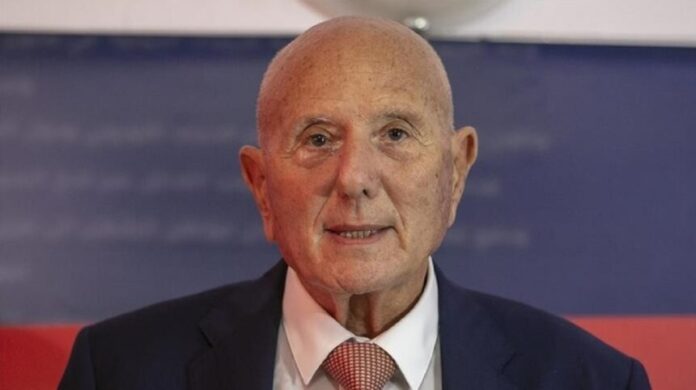
On 4 December 2025, in Tunis, Ahmed Néjib Chebbi recorded a video; police then arrested him at his home. At 81, the lawyer and veteran opposition figure went to prison following a twelve-year sentence in the so-called conspiracy case. This portrait of Néjib Chebbi traces more than half a century of political engagement. It begins under Bourguiba, passes through the Ben Ali dictatorship and the 2011 revolution, and ends, for now, under the presidency of Kaïs Saïed.
A Final Video Before the Arrest
For several days, two police cars and about ten plainclothes officers kept watch on his home, according to AFP. His daughter, the lawyer Haïfa Chebbi, announced the arrest in tears. In his video, the opponent says he is going to prison with a clear conscience. He maintains that he has done nothing wrong.
The scene is striking in its contrast. The man is well known, elderly and worn by the years. Yet he walks toward the cell without resistance.
Years of Struggle, from 1968 to the Revolution
It all began in 1968. As a student, Ahmed Néjib Chebbi was arrested in the context of the student movements, under the regime of Habib Bourguiba. He became a lawyer and took on political cases. He was also active in the far-left movement Perspectives.
In 1983, he founded the Progressive Democratic Party, which was legalized in 1988. Chebbi led it until 2006. He also ran Al-Mawqif, an opposition weekly.
Under Ben Ali, he relied mainly on one form of protest: the hunger strike. He resorted to it in 2005, 2007 and 2010. In 2005, he fasted alongside left-wing activists and figures close to the Islamists. Their action gave rise to the 18 October Movement.
The 2011 Turning Point
The fall of Ben Ali changed his course. Ahmed Néjib Chebbi became Minister of Regional and Local Development in the transitional government. On 23 October 2011, he was elected to the National Constituent Assembly. His party took the name Al-Joumhouri.
He ran in the 2014 presidential election without winning. Some observers criticize his alliances after the revolution. Others note that he never left the opposition.
The Last Chapter: The National Salvation Front
After 25 July 2021, Chebbi co-founded the National Salvation Front, a coalition opposed to the decisions of President Saïed. He was subsequently tried in the conspiracy case. He appeared before the court while at liberty and received 18 years in prison at first instance. On appeal, the sentence was reduced to twelve years. According to Human Rights Watch, he declined to lodge an appeal before the Court of Cassation.
On 3 September 2026, the Court of Cassation upheld the sentences of the other defendants, which are now final. Since 1 October, according to Business News, Chebbi has been on hunger strike to protest restrictions imposed on detainees. More than 150 public figures have signed a petition calling for his release.
A Path Woven into Tunisia’s Political History
This personal trajectory mirrors the history of the country. Under Bourguiba, student dissent was repressed. Under Ben Ali, the opposition won few freedoms. After 2011, it discovered institutional politics. Since 2021, presidential power has been consolidated.
Tunisian and international NGOs denounce a decline in rights. President Saïed rejects outside criticism. He described as interference a European Parliament resolution adopted in November 2025.
What Future for the Opposition?
Domestic remedies have been exhausted. Chebbi’s relatives and several NGOs are calling for the sentences to be overturned. One question remains: what becomes of an opposition deprived of its historic figures? The coming months will show whether it can regroup.
Sources: AFP, Business News, Kapitalis, L’Économiste Maghrébin, Maghreb Emergent, Reporters Without Borders, Human Rights Watch.
Je peux aussi vous fournir les métadonnées SEO (titre, description, slug, étiquettes) séparément, si vous en avez besoin pour le CMS.