
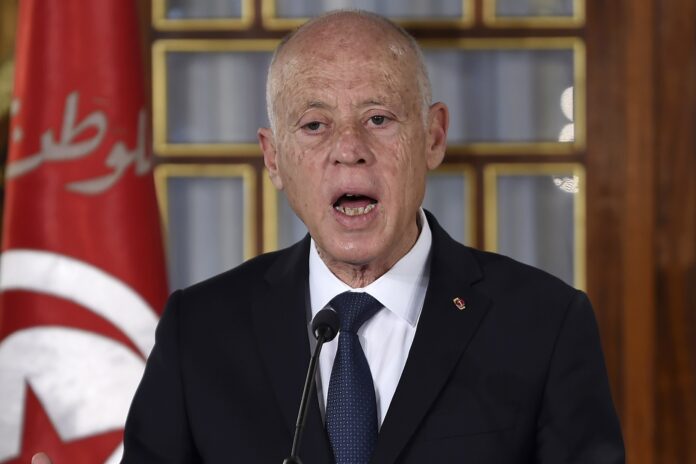
This is no longer an isolated warning. It is a documented finding, delivered from Geneva by the United Nations’ highest moral authority on human rights. On Thursday, UN Human Rights Chief Volker Türk demanded that Tunisia put an end to its systematic repression of civil society, journalists and political opponents — categories that, one by one, are seeing their vital space shrink under the combined weight of judicial proceedings and administrative obstruction. A solemn call that comes as two emblematic organizations have been suspended within days of each other.
The Law as an Instrument of Silencing
There is a cruel irony in the method. What characterizes the repression denounced by the UN is not, primarily, heavy-handed arrests or arbitrary closures. It is the law itself — or rather, its distorted use — that serves as the lever. Audits invoked at carefully chosen moments, administrative irregularities brandished as pretexts, decrees drafted in deliberately vague terms: a set of legal tools that make it possible to paralyze, without striking a visible blow, decades of civic and human rights work.
The suspension, on Tuesday, of Avocats Sans Frontières for a period of thirty days by a Tunisian court is the most recent illustration. The organization, whose teams work with the most vulnerable populations, found itself overnight unable to carry out any of its missions. A few days earlier, it was the Tunisian League for Human Rights that had suffered the same fate — an institution founded in 1977, a pioneer in the Arab world, brought to a standstill by a court ruling.
For Volker Türk, the pattern is now too consistent to be coincidental. “We are observing a growing trend in which Tunisian authorities are resorting to the use of judicially imposed sanctions to curb the exercise of the right to freedom of association, with the barest consideration for the principles of legality, necessity and proportionality required for such limitations to be permissible,” he stated.
Journalists Behind Bars for Doing Their Job
While civil society organizations navigate administrative courts, the independent press faces prison cells. On April 24, journalist Zied El Heni was arrested and placed in pre-trial detention. The charge: a penal provision criminalizing the use of telecommunication networks to “harm others” — a formulation so broad it can apply to virtually any form of critical reporting or commentary.
His case is part of a pattern that is far from incidental. The previous year, twenty-eight journalists — among them Mourad Zghidi — had been arrested, prosecuted and sentenced to various prison terms for acts directly related to the exercise of their profession. The primary legislative tool deployed against them is a 2022 decree-law officially dedicated to combating cybercrime, but whose broadly worded provisions allow authorities to pursue journalists for articles, interviews or public statements.
It is precisely this text that the UN is urging Tunisian lawmakers to revise. An amendment process is reportedly underway, but its outcome remains uncertain. Türk was unambiguous in his demand: “I urge the Tunisian authorities to release immediately and unconditionally all those detained or imprisoned for having expressed their views, protected under international human rights law, and to lift all arbitrary restrictions on the freedoms of expression and association.”
The Long Shadow of the 2021 Power Shift
To understand the trajectory that led to this situation, one must return to the summer of 2021. On July 25 of that year, President Kaïs Saïed suspended parliament, assumed sweeping executive powers and launched a constitutional overhaul that resulted, in 2022, in the adoption of a new foundational text concentrating authority overwhelmingly in the hands of the executive. This institutional power grab, described by its supporters as a “correction of the course,” was seen by opponents — and by much of the international community — as a clear break with the gains of the 2011 revolution.
For it is precisely that legacy which is now at stake. Tunisia had been, in the aftermath of the uprising that toppled Ben Ali, the only country of the Arab Spring to have successfully transitioned toward a pluralist system. A progressive constitution, free elections, a thriving civil society: achievements that earned the country, in 2015, the Nobel Peace Prize awarded to the National Dialogue Quartet.
Today, the UN also raises the alarm over the absence of a functioning constitutional court — an institution essential to ensuring that laws and decisions respect citizens’ fundamental rights. Without this safeguard, legal recourse remains limited and abuses difficult to contain. “Tunisia’s democratic and human rights gains after 2011 must be maintained, not progressively dismantled,” warned Volker Türk, in terms that sound less like a recommendation than a stark warning.
Behind the diplomatic language and official communiqués, a fundamental question now looms with growing urgency: how far is the international community willing to go to ensure that its warnings amount to something more than statements without consequence? And within Tunisia itself, what forces — political, legal, social — still hold enough weight to influence a trajectory that the UN, without equivocation, judges to be deeply troubling?