
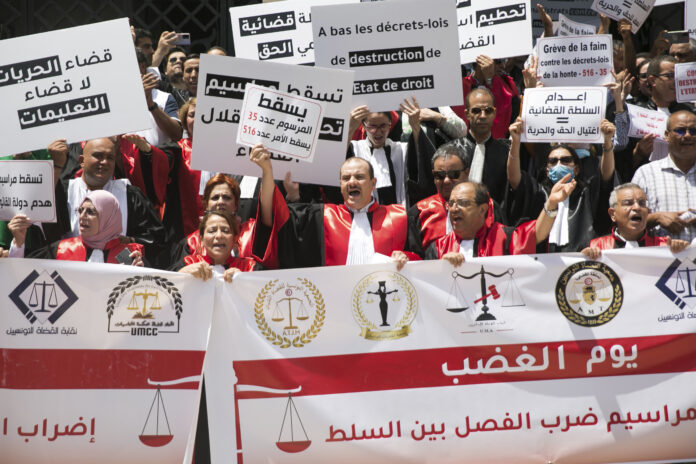
He did not waver. For nearly thirty years, Anas Hmaidi has defended the independence of the Tunisian judiciary with a consistency that his peers readily describe as rare. On April 6, 2026, it was justice itself — or at least one of its chambers — that caught up with him. The Tunis Court of First Instance sentenced him to one year in prison. The stated charge: obstruction of labor freedom. The backdrop, according to the association he presides over: his trade union resistance against an executive branch that has, since 2022, continued to tighten its grip on the judiciary.
A verdict that lands like a sledgehammer
On Monday, April 6, the sixth criminal chamber of the Tunis Court of First Instance delivered its judgment. One year in prison. The case number — 4135 — will mean nothing to the general public. But in the corridors of Tunisian courthouses, it already resonates as a wake-up call.
The facts for which Hmaidi is being prosecuted date back to 2022, a pivotal year in the recent history of the Tunisian judiciary. That year, President Kaïs Saïed dissolved the Supreme Judicial Council by decree in February, then dismissed 57 judges in June through a simple presidential act. The judiciary was thrown into turmoil. Hmaidi, at the head of the Tunisian Magistrates’ Association (AMT), led the rebellion. He organized, mobilized, spoke out. Too much, in the eyes of some.
Four years later, it is for these very actions that the prosecutor’s office, acting according to the AMT under the supervision of the Ministry of Justice, prosecuted him. The chosen charge — obstruction of labor freedom — is perceived by his defenders as a political recharacterization of a perfectly legitimate trade union commitment.
A judicial journey strewn with obstacles
Even before the verdict, the procedure had fueled controversy. The case traveled through three courts — Monastir, Le Kef, Tunis — through referral decisions that the AMT describes as arbitrary, lacking solid legal foundation. One of these decisions is alleged to have been made by an appellate chamber in the middle of the judicial vacation period, which, according to the association, constitutes a frontal violation of basic fair trial rules.
Hmaidi had invoked his judicial immunity. In vain. The lifting of this immunity, decided by a provisional council of the judiciary whose own legitimacy is contested, was the subject of an appeal for annulment. It went nowhere. At each stage, the defense hit procedural obstacles that the AMT attributes to a deliberate desire by the executive to see this case through to the end, whatever the cost.
“A serious precedent”
In its statement published the day after the judgment, the AMT’s executive bureau does not try to smooth things over. It speaks of an “inequitable decision,” of “facts fabricated from scratch,” of “acknowledged political pressure.” Above all, it points to what it considers a first in the country’s judicial history: never, under any regime, had a magistrate been brought before a court because of his trade union activity.
This claim is worth emphasizing. Tunisia endured decades of authoritarianism under Bourguiba and then Ben Ali. Judges were sidelined, transferred, shelved. But the direct criminalization of a magistrate’s associational engagement would, according to the AMT, constitute a line crossed for the first time.
The association calls on its members to “remain united around their organization” and to continue practicing their profession according to their oath, despite the pressures. It also announces that Anas Hmaidi will appeal the judgment and use all available legal remedies.
Tunisian justice put to the test by concentrated power
To understand what is really at stake behind this conviction, we must return to that turning point of July 25, 2021. On that day, President Kaïs Saïed suspended Parliament, concentrated executive and legislative powers in his hands, and set Tunisia on an unprecedented political trajectory since independence. A new Constitution, adopted in 2022, enshrines this institutional reconfiguration in favor of the executive.
The dissolution of the Supreme Judicial Council a few months later deprived the judiciary of its independent governing body. A provisional council replaced it, lacking the same constitutional legitimacy and the same distance from the executive. The 57 dismissals of June 2022 completed the establishment of a climate of diffuse fear in courtrooms.
It is in this environment that the AMT has continued to function, to publish, to denounce. Today, it is one of the few organized voices that publicly documents what its executive bureau calls “the excesses of the executive in the management of justice outside institutions and far from the law.” Its institutional survival, in this context, is itself an act of resistance.
What this judgment says about Tunisia today
A press conference is scheduled for April 10. The AMT intends to detail there the “serious developments” related to the conviction of its president and explain the context to the public. Judicial appeals will follow their course.
But beyond the procedures, a more fundamental question arises: In a Tunisia where checks and balances have gradually shrunk since 2021, who remains capable of freely speaking the law? Who can still, without risking their freedom, defend the independence of those who are supposed to settle citizens’ disputes?
Anas Hmaidi devoted three decades to raising this question. The Tunis Court of First Instance has just given him its answer. It is not likely the last answer.