
It was an unusual political gathering, held under the shadow of both a recent loss and a growing sense of national drift. The central council of the Parti Patriotique Démocratique Socialiste (PPDS), a small but vocal left-wing opposition party, convened in Tunis on April 25 and 26, 2026. The meeting was dedicated to the memory of Belkacem Yaacoubi, a deceased party figure. In attendance were representatives from regional branches, the European diaspora, the party’s women’s commission, and its revolutionary youth organization, Kifah. Over two days of closed-door debates, the council produced a sweeping final communiqué. The document blasts the Tunisian government’s economic choices, denounces what it calls the “erosion of liberties” under President Kaïs Saïed, and aligns the party firmly with anti-imperialist causes from Gaza to Cuba. The “why” of this meeting is clear: the PPDS, isolated from power, is trying to reaffirm its ideological compass and craft a response to a political landscape it sees as increasingly hostile.
An uncompromising stance on a fractured world
Delegates at the PPDS central council April 2026 session did not shy away from grand geopolitical pronouncements. Their final text starts with a global diagnosis. The party argues that the recurring crises of capitalism are pushing imperialist powers, led by the United States, to multiply conflicts in a desperate attempt to maintain control. They point to the decline of the dollar and the rise of alternative currencies as signs that a new world order is struggling to be born.
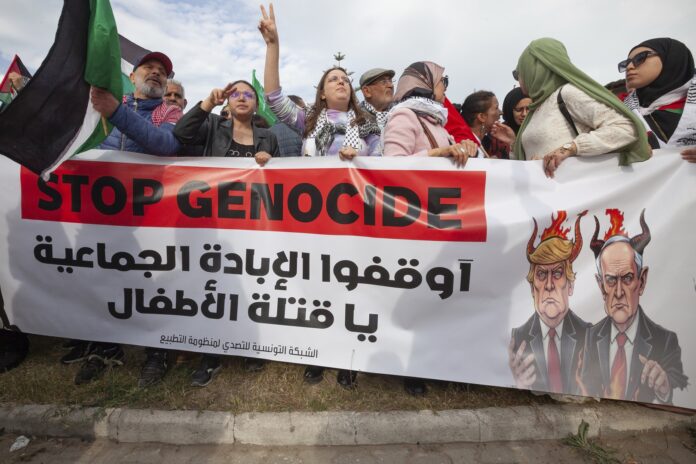
The communiqué then moves through a litany of solidarities. It condemns what it calls the “American-Zionist aggression against Iran,” affirming Tehran’s right to defend its sovereignty. It expresses support for Venezuela’s President Maduro, denouncing his “kidnapping,” and stands with Cuba against the US blockade and threats of invasion. The party also accuses France of mobilizing terrorist groups to destabilize the Sahel region, while voicing solidarity with what it sees as revolutionary movements crushed under “fascist” regimes in Turkey and India. On the Arab front, the PPDS is unequivocal: full support for Palestinian resistance in Gaza, rejection of normalization with Israel, and solidarity with Lebanese resistance fighters facing attempts at disarmament.
Tunisia: a long list of grievances against the Saied government
It is on the national level, however, that the PPDS central council April 2026 offers its most detailed and pointed critique. The party insists Tunisia’s current crisis is not circumstantial. They say it is the direct result of economic policies that perpetuate colonial-era dependencies. The communiqué attacks the government’s gradual dismantling of subsidy systems, specifically citing the withdrawal of subsidized products and the promotion of alternatives like “bran bread” – measures they say attack the right to food and burden the poorest.
The council also holds the president and parliament responsible for what it views as attacks on national sovereignty in renewable energy. The ratification of new concessions in Gafsa, Sidi Bouzid, Gabès, and Kairouan is seen as a step towards privatizing the national electricity and gas company, STEG. On freedoms, the PPDS demands the repeal of Decree-Law 54 and the establishment of the long-awaited Constitutional Court. It rejects restrictions on political activity and expresses solidarity with the powerful UGTT trade union federation, which it says is being targeted by “arbitrary measures.” The party also demands the immediate release of Ghassen Henchiri, a member of its political bureau, imprisoned on charges it calls “unfounded.” Finally, the council condemns rising racist speech in Tunisia, holding the “Saïed regime” fully responsible.
A fragmented left searching for a common path
The PPDS central council April 2026 session takes place in a Tunisian political landscape that has been profoundly reshaped since July 25, 2021, when President Saïed seized near-total control. While Saïed successfully sidelined the once-dominant Ennahdha movement and the old guard of Nidaa Tounes, the radical left has not prospered. The PPDS remains an extra-parliamentary force. Its real influence is felt more in grassroots union committees and pro-Palestinian solidarity campaigns than in electoral politics. The collapse of the Popular Front, a previous leftist coalition, has left a void that the PPDS has struggled to fill.
Nouri Beltoumi, the PPDS’s secretary-general, has repeatedly called for unity. But attempts to build a “national progressive front” keep stalling amid ideological differences and personal rivalries. The economic backdrop is grim. Inflation has hovered above 10% for much of the past year. Official unemployment stands near 17%, and shortages of basic goods have sparked localized protests. Migration, another issue the PPDS raised, has become deeply toxic after President Saïed’s past remarks about “hordes” of sub-Saharan migrants and recent street clashes in Sfax. In this context, the PPDS’s message – blending anti-imperialism, social justice, and defense of liberties – resonates with a hard core of activists but has yet to break through to a wider, exhausted population.
A radical voice, an uncertain echo
The Conseil central du PPDS avril 2026 has spoken. Its members leave Tunis with a detailed roadmap for opposition, yet the path ahead remains unclear. The party’s call for a “national progressive front” free from Islamists, Destourians, and the Salvation Front is ambitious. But can this radical diagnosis, powerful in its internal consistency, overcome the deep fragmentation of the Tunisian left and translate into a popular movement? The PPDS is betting that the rising cost of living and the steady squeeze on public freedoms will eventually provide an opening. For now, though, the party remains more of a critical observer than a credible alternative, its voice clear but its echo in the streets of Tunis still uncertain.