



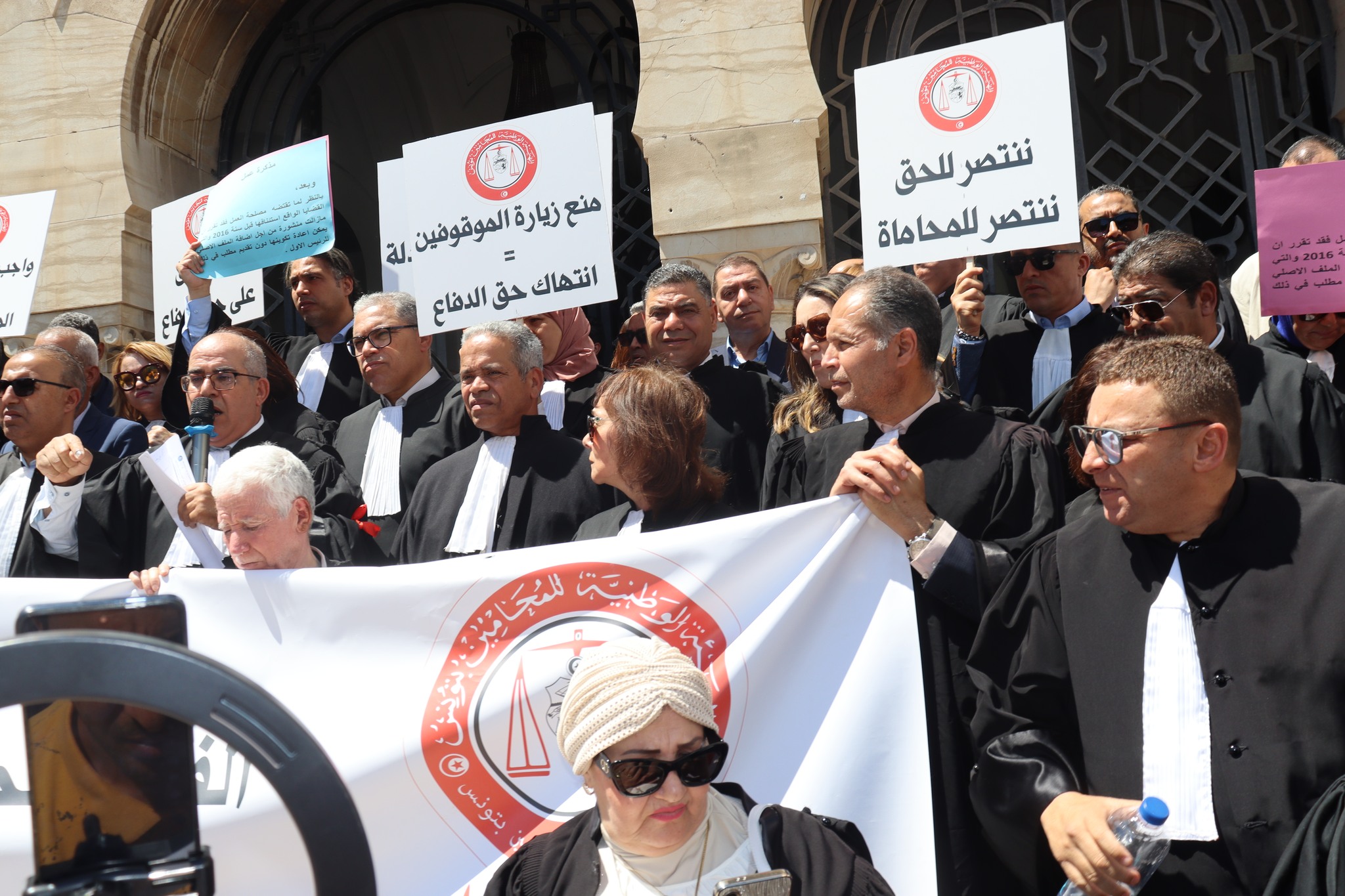
Since Tuesday, May 19th, Tunisian courtrooms have been half-empty. Hundreds of lawyers in black robes have abandoned their benches, transforming judicial palaces into sites of silent protest. This work stoppage bears little resemblance to the typical labor dispute over wages or working hours. It represents a profound fracture between the Tunisian bar and a government accused of subordinating the judiciary to executive interests. With a nationwide mobilization planned for June 18th, the Tunisian Order of Lawyers is signaling the prospect of sustained judicial paralysis, forcing the capital to confront a question it has avoided for years: does an independent justice system still exist in Tunisia?
Demands That Transcend Professional Grievances
On the surface, the Tunisian Order of Lawyers lists six grievances: judicial sector reform, improved working conditions, the restoration of the Supreme Council of Magistrates, modernization of court infrastructure, the sustainability of the lawyers’ pension fund, and an end to prosecutions targeting certain bar members. In reality, these demands point toward a more serious diagnosis: that of a judicial apparatus in disrepair, directed from the top by the state executive.
Boubaker Blathaout, the bar’s dean, articulated the underlying stakes during the first gathering: “We defend our right to freedom, we guarantee fair trials, and we demand that justice not be used as an instrument of political conflict.” This seemingly basic assertion carries outsized symbolic weight in the current Tunisian context. It signals that the legal profession has grown weary of functioning as a willing extra in a system where judicial robes too often conform to the wishes of those in power.
The lawyers’ placards conveyed the same message with cutting directness: “No to the dismissal of the bar’s demands. No to the denial of justice.” Other signs read: “No restriction of the right to defense,” and “Guarantees of fair trial must exist.” These are not the slogans of a professional association seeking mere salary increases. They are declarations about the nature of state power itself.
The Crux: A Supreme Council in Limbo Since 2022
The fixation on the Supreme Council of Magistrates is not coincidental. After President Kais Saied’s seizure of power in February 2022—which brought about the dissolution of this institution—lawyers expected a swift restoration of this constitutional safeguard. Yet four years later, the CSM remains quasi-nonexistent as a functioning body. This absence is not a matter of bureaucratic sluggishness; it reflects a deliberate intent to keep judges dependent on executive will.
Without this council, magistrates lack any meaningful protection against political pressure. Appointments, transfers, and dismissals now flow from administrative decisions made without institutional counterweight. Lawyers view this situation as symptomatic of a deeper pathology: the progressive instrumentalization of judicial power. Several attorneys have themselves faced criminal prosecutions for alleged financial corruption—charges they regard as retaliatory measures.
The question haunting the bar is uncomfortable but essential: In a state where the executive controls judicial outcomes, can there be justice? The international legal community has answered this question with mounting alarm. The International Commission of Jurists, Amnesty International, and MEDEL (the Mechanism for Cooperation among the Maghreb and West) have all issued reports documenting what they describe as a “grave erosion” of judicial independence in Tunisia.
Government Silence as a Form of Response
When confronted with this mobilization, the government has chosen indifference. Leïla Jaffel, Minister of Justice since October 2021, has consistently refused substantive dialogue with the bar association. The ministry went so far as to announce, even before the strike began, that courts would operate normally—a gesture of pure defiance. No offer of compromise. No opening to negotiation. Only refusal to listen.
This posture reveals something consequential: the executive views the judicial branch as its exclusive prerogative. By ignoring the bar’s demands, it sends a message to judges who might still harbor doubts about their subordination: independence is not a right but a revocable privilege.
A Judicial System Corroded by Institutional Breakdown
The lawyers’ strike does not emerge from nowhere. It responds to manifest deterioration across the judicial sector. International reports converge on a shared diagnosis: Tunisia’s judicial independence is undergoing systematic erosion.
The magistrates themselves have sounded alarms. The Tunisian Association of Judges has noted that the 2025-2026 judicial year marks the third consecutive year without institutional guarantees of independence. Rule-of-law violations accumulate: opposition politicians tried via videoconference on charges of “conspiracy against state security,” prolonged detention without procedural safeguards, a judicial system patently segmented along political lines.
Parallel to these political machinations, material conditions have deteriorated. Court clerks are understaffed. Buildings decay. Case delays stretch indefinitely. For lawyers—already accustomed to navigating a system grown hostile to robust defense—this combination breeds exhaustion. After years of unanswered requests for dialogue, patience has curdled into resistance.
The Contours of a Political Impasse
This strike exposes a fundamental contradiction at the heart of post-2022 Tunisia. The country adopted a constitution in 2014 whose Article 102 explicitly enshrines judicial independence. But once a president decides to exercise power differently, that independence becomes an inconvenient obstacle to be circumscribed or eliminated.
Lawyers striking today are not fighting for salary increases or shorter hours. They are fighting for the professional capacity itself—which is to say, fighting for the fundamental right of every person to competent legal defense. When the state renders the practice of defense impossible, it dismantles the foundations of rule of law.
The government, for its part, appears to be betting on attrition. It calculates that lawyers, facing lost income from the strike, will eventually accept the status quo. But this calculation overlooks a crucial social reality: no large-scale professional mobilization remains confined to its original grievances for long. It becomes symbolic, a crystallization of broader collective frustration. In a Tunisia already fatigued by political instability, the lawyers’ movement may well become a warning sign for growing swaths of the population.
The Critical Weeks Ahead
The timeline is compressed. Regional strikes will be staged through June 8th, followed by the national gathering on June 18th. If the bar achieves the level of mobilization it anticipates, courts could genuinely grind to a halt. No democracy has ever endured for long without a functioning judicial apparatus, however imperfect.
Two scenarios remain possible. In the first, the government makes partial concessions: it opens dialogue, accepts some reforms, restores the Supreme Council. This would require the executive to acknowledge limits to its power. In the second scenario, the strike persists, tensions escalate, and collateral damage mounts—hesitant investors, eroded public confidence, international legitimacy questioned.
Between these paths, the government has not yet chosen. Perhaps it has not yet grasped that the choice is urgent.
A Democracy at a Crossroads
The mobilization of Tunisia’s lawyers raises a broader question: Can a regime long prosper by evacuating its institutions of meaning? The answer Tunisia provides in the coming weeks will reveal much about its capacity to construct a durable rule of law—or its capitulation before that task


