



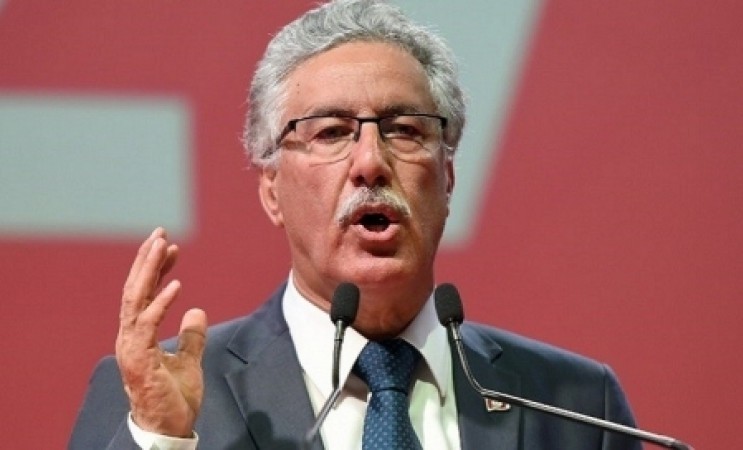
A man filmed with his face uncovered, calling for the execution of a 76-year-old veteran opposition figure: that is what a video posted online in recent days shows, targeting Hamma Hammami, secretary general of the Tunisian Workers’ Party, along with several other political and legal figures in the country. Circulated on Tunisian social media in mid-July, the footage prompted Hamma Hammami to file a legal complaint, while French political leader Jean-Luc Mélenchon publicly called on Tunisian authorities to guarantee his protection and prosecute those behind the threats. Far from an isolated incident, the episode has revived a long-standing debate over the safety of voices critical of the government in Tunisia.
What the video shows
For more than three minutes, an unidentified man singles out Hamma Hammami by name, along with lawyers Samir Dilou, Mohamed Abbou and Ezzeddine Hazgui, and Rached Ghannouchi, the historic leader of the Ennahdha party. His tone leaves little room for ambiguity: the man repeatedly calls for Hamma Hammami’s execution, states he is personally prepared to carry it out, and describes a scenario in which those named would be rounded up and bound together. He also calls on the authorities to prevent some of them from leaving the country.
To justify his remarks, the man attributes to Hamma Hammami statements about a planned mobilization starting on July 25 — a date associated with the political process launched by President Kais Saied since 2021. That attribution could not be independently verified. Several Tunisian outlets, including Business News, chose not to broadcast the full video, limiting themselves to reporting its content for informational purposes.
A complaint, and a call from Paris
Given the severity of the remarks, Hamma Hammami announced he had filed a complaint with Tunisian authorities. His move quickly resonated beyond the country’s borders: Jean-Luc Mélenchon, founder of France’s La France Insoumise party, publicly voiced concern, describing Hamma Hammami as a comrade and a longtime advocate for democratic freedoms. He called for his security to be guaranteed and for those responsible for the threats to be punished, while stressing that such violence seemed foreign to what he described as his image of Tunisia, a country he called a friend.
The appeal was echoed by several supporters of the Workers’ Party, who are calling on the public prosecutor’s office to take up the case without delay, both to ensure effective protection for Hamma Hammami and to identify the video’s author. As of now, neither the prosecutor’s office nor the Interior Ministry has publicly commented on the state of the investigation or on any protective measures taken on the party leader’s behalf.
A climate of tension that extends beyond one man
What this affair reveals, above all, is the persistence of a climate of threats targeting political opponents, lawyers, human rights defenders and journalists in Tunisia. For several years, voices critical of the government have regularly reported online harassment campaigns, without their authors always being identified or prosecuted with the same rigor applied to other forms of expression. Opinion pieces devoid of any call to violence have, in the past, led to legal proceedings, feeding a sense among several human rights organizations that online content is treated unevenly depending on whether it supports or criticizes those in power.
A figure shaped by decades of repression
This is not Hamma Hammami’s first confrontation with the authorities. A former underground spokesman for the Tunisian Communist Workers’ Party under the rule of Ben Ali, he was arrested and imprisoned on several occasions and, according to accounts documented at the time, reportedly subjected to mistreatment in detention. After becoming secretary general of the Workers’ Party following the 2011 revolution, he established himself as one of the most consistent voices of the Tunisian left, including in his criticism of the new institutional framework put in place by Kais Saied since 2021.
Nor is this the first time Hamma Hammami has faced threats: similar episodes in the past earned him close protective security, which has since been scaled back. This latest warning thus comes against the backdrop of a Tunisian political climate still marked by sharp tensions between supporters and opponents of the process under way since 2021, one in which the question of freedom of expression continues to divide.
The investigation opened following Hamma Hammami’s complaint will now need to establish the identity of the video’s author. It remains to be seen whether the mobilization sparked by this affair, both within Tunisia and abroad, will help change how online threats against critical voices are handled by the country’s justice system.


