



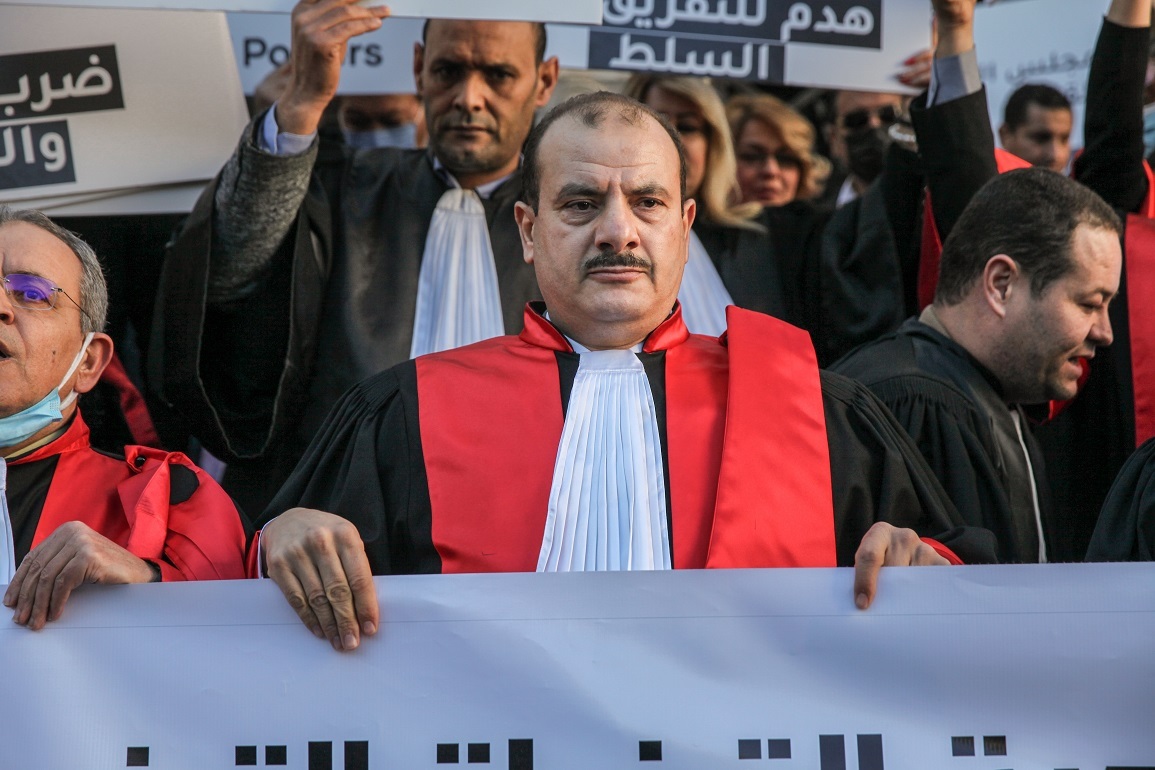
He was not in the courtroom on Wednesday, July 1, when the correctional chamber of the Tunis Court of Appeal sealed his fate. Anas Hmaidi, head of the Association of Tunisian Magistrates, has had his one-year prison sentence for obstructing freedom of work upheld — this time with an order for immediate enforcement. Absent from both hearings granted at his defense team’s request, he is believed, according to a judicial source cited by the Tap news agency, to have already left the country. At the heart of the case: a disrupted preliminary hearing at the Monastir court in June 2022, amid a wave of strikes by Tunisian judges.
Four Years of Proceedings, a Verdict Reaffirmed
The story begins in 2022. On June 13 of that year, amid a broader judicial mobilization, Anas Hmaidi was accused of deliberately disrupting a preliminary hearing at the Monastir court of first instance. The context matters: weeks earlier, 57 judges had been dismissed by presidential decree, triggering outrage within the judiciary.
For the case to proceed, Hmaidi’s judicial immunity first had to be lifted. That happened on September 20, 2022, by decision of the Provisional Judicial Authority. The investigation moved forward from there, eventually leading to trial on charges of obstructing freedom of work under Article 136 of the Penal Code.
The first-instance verdict came on April 6, 2026: the sixth correctional chamber of the Tunis court of first instance sentenced Hmaidi to one year in prison. He appealed — but never appeared at the subsequent hearings, despite two postponements granted to his lawyers. By then, the judicial source noted, he had already left Tunisian territory.
A Defense That Fought to the End
His legal team did not hold back. Before the first-instance court, they had requested a trial postponement pending the outcome of an appeal against the lifting of Hmaidi’s immunity, as well as consideration of a Court of Cassation ruling on a request to relocate the case. Both requests were denied.
His lawyers also pointed to what they described as procedural flaws, particularly regarding fair trial guarantees and the union rights meant to protect magistrates organized within a professional association.
The Association of Tunisian Magistrates has consistently maintained that the proceedings were flawed from the start. The organization points to the case’s transfer between multiple courts, an investigation it says was rushed, and the fact that its president was never questioned before being referred to trial. More broadly, the AMT views the case as a form of retaliation against Hmaidi’s union activism and his advocacy for judicial independence — and has called from the outset for the charges to be dropped.
A Trial Rooted in a Deeper Crisis
To understand this case, one must go back to the rupture of 2022. The dismissal of 57 judges that year, officially justified as an anti-corruption measure, was widely seen within the judiciary as a heavy-handed move lacking sufficient safeguards. The response came swiftly: strikes, sit-ins, sustained mobilization led in large part by the AMT, an association founded in 2016 to defend judicial independence from political power.
This episode fits into a broader institutional realignment underway in Tunisia since 2021, which several human rights organizations describe as a gradual erosion of the separation of powers. Against this backdrop, legal proceedings targeting union, political, and media figures critical of the government have multiplied, fueling concerns over pluralism and judicial independence in the country.
The Court of Appeal’s ruling does not close off the legal avenues still available under the law. Whether Anas Hmaidi, now outside Tunisia, will pursue them remains an open question — as does what this ruling will ultimately mean for the standoff that has pitted part of Tunisia’s judiciary against the executive for the past four years.


